· Updated · AI Workforce · 6 min read
AI Employee vs Virtual Assistant: What SMBs Should Actually Choose
Compare AI employees vs virtual assistants: real costs, tasks each handles better, and when to use both. Save 50%+ on staffing with AI.
AI Employee vs Virtual Assistant: What SMBs Should Actually Choose
You need help. Your to-do list is overflowing, customers are waiting, and the back-office work never stops. The question isn't whether to get help — it's what kind.
Most SMBs default to hiring a virtual assistant. But in 2026, there's a better option that costs less, scales faster, and doesn't call in sick. Here's how an AI employee compares to a virtual assistant — and when each one makes sense.
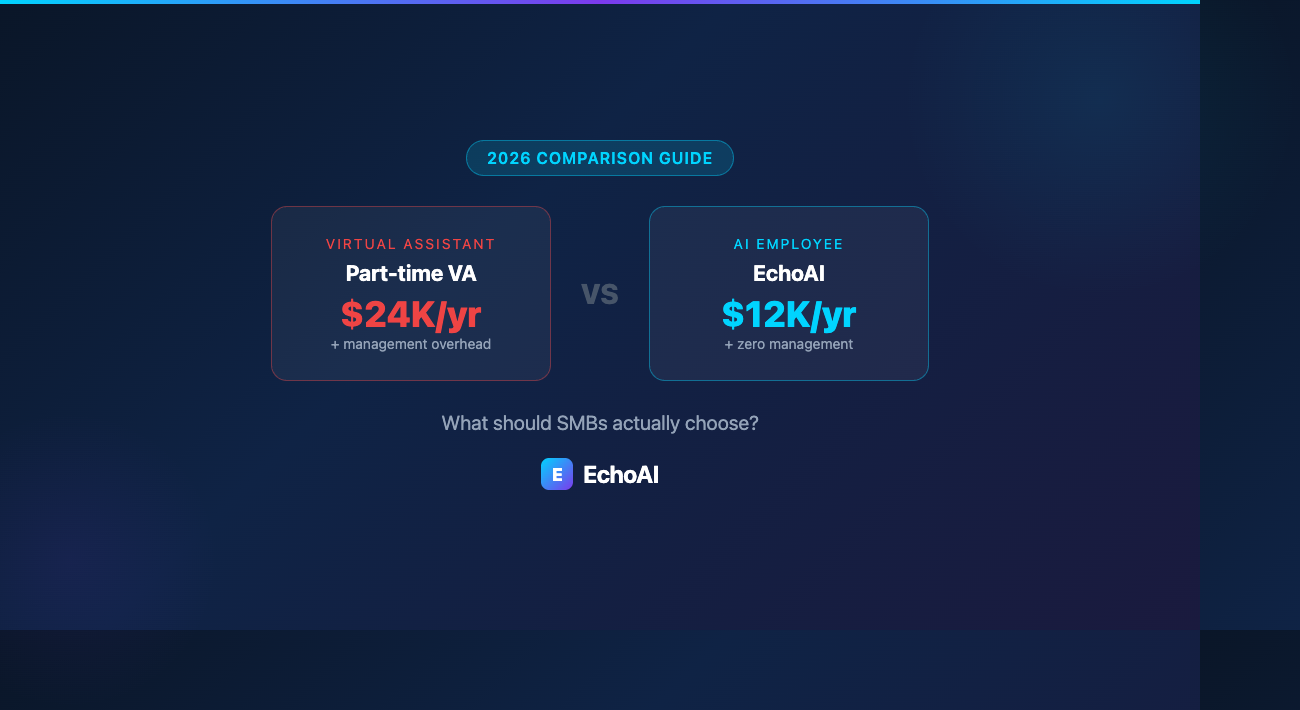
The short answer: A part-time virtual assistant costs $18,000–$32,000/year for a 30-person company — and that doesn’t count your management time. An AI employee doing similar work costs $12,000–$15,000/year with 24/7 coverage and near-zero management overhead. The real question isn’t which one wins — it’s which tasks each one should handle. Here’s the breakdown.
What a Virtual Assistant Actually Costs
A virtual assistant (VA) sounds affordable — until you add up the real costs:
| Cost Component | Monthly | Annual |
|---|---|---|
| Base rate (part-time, 20 hrs/week @ $15-25/hr) | $1,200–2,000 | $14,400–24,000 |
| Onboarding & training | $500–1,500 (one-time) | Amortized |
| Management overhead (your time) | 3–5 hrs/week | 156–260 hrs/year |
| Turnover & re-hiring | $2,000–5,000 per turnover | Varies |
| Tool licenses (email, CRM, etc.) | $50–200 | $600–2,400 |
Real annual cost: $18,000–32,000+ for a part-time VA, not counting your management time or the productivity hit during turnover.
What an AI Employee Actually Costs
An AI employee platform handles the same tasks without the overhead:
| Cost Component | Monthly | Annual |
|---|---|---|
| Platform subscription | $1,000–2,500 | $12,000–30,000 |
| Setup time | 2–4 hours (one-time) | Negligible |
| Management overhead | 30 min/week | 26 hrs/year |
| Turnover | $0 | $0 |
| Tool licenses | Included | Included |
Real annual cost: $12,000–30,000 with near-zero management overhead.
Head-to-Head: Where Each One Wins
Tasks where AI employees dominate:
- Answering repetitive questions — AI handles FAQ, order status, policy lookups instantly, 24/7. A VA responds during work hours with delays.
- Processing documents — Invoices, forms, expense reports. AI processes in seconds. A VA takes minutes per item with occasional errors.
- Data entry & CRM updates — AI never makes typos, never forgets to update a record, never loses track of follow-ups.
- Multi-language support — AI speaks every language out of the box. A VA typically speaks 1–2.
- Scaling — AI handles 10 requests or 10,000 without hiring anyone new.
Tasks where a virtual assistant is still better:
- Complex judgment calls — When a situation requires nuanced understanding of your specific business context and relationships.
- Creative work — Writing custom outreach, designing presentations, brainstorming.
- Relationship building — Personal phone calls, client relationship management, networking.
- Physical tasks — If something needs to be done in the real world.
The Math for a 30-Person Company
Let's say you need someone to handle customer support triage and basic HR admin:
Virtual Assistant (20 hrs/week):
- Cost: $24,000/year (salary + overhead)
- Coverage: 20 hrs/week, weekdays only
- Turnover risk: High (average VA tenure is 1.5 years)
- Your management time: 150+ hrs/year
AI Employee:
- Cost: $15,000/year (platform subscription)
- Coverage: 24/7, every day
- Turnover risk: Zero
- Your management time: 26 hrs/year
Net savings: $9,000+/year plus 124 hours of your management time back.
The Honest Answer: Use Both
The best SMBs in 2026 aren't choosing one or the other — they're using AI for the repetitive work and VAs (or employees) for the judgment-heavy work.
Here's the pattern:
- AI handles: FAQs, document processing, data entry, scheduling, basic customer inquiries, payment reminders
- Humans handle: Complex customer escalations, creative projects, relationship management, strategic decisions
This lets your human team focus on work that actually requires human judgment — instead of burning out on repetitive tasks.
FAQ: AI Employee vs Virtual Assistant
Q: What costs more — a virtual assistant or an AI employee?
A: A part-time VA costs $18,000–$32,000/year plus your management time (150+ hours/year). An AI employee costs $12,000–$30,000/year with about 26 hours of management annually. Plus an AI doesn’t turnover — average VA tenure is 1.5 years.
Q: Can an AI employee replace my virtual assistant entirely?
A: For repetitive tasks — yes. FAQ responses, document processing, data entry, scheduling, payment reminders. For complex judgment calls, creative work, and relationship building — your VA or employees are still better. Use both.
Q: What tasks should I give to an AI employee first?
A: The ones that are repetitive, follow clear rules, and have high volume: customer FAQ responses, invoice processing, CRM updates, appointment scheduling, basic data entry.
Q: Does an AI employee work 24/7?
A: Yes. A VA works their contracted hours (typically 20 hrs/week, weekdays). An AI employee answers questions, processes documents, and sends reminders around the clock without overtime pay.
Q: What happens when an AI employee encounters something it can’t handle?
A: Good AI platforms escalate uncertain cases to a human. You set the confidence threshold — the AI handles everything it’s sure about and flags the rest for human review.
Q: How long until an AI employee is productive?
A: Initial setup takes 2–4 hours. Full calibration on your workflows takes 1–2 weeks of human review. After that, it runs autonomously with periodic oversight.
How to Start
- Audit your tasks — List everything your VA or admin does in a week. Mark which ones are repetitive and which require judgment.
- Deploy AI for repetitive work — Set up an AI employee for the tasks that follow clear patterns. See how AI handles 80% of support tickets for SMBs.
- Upskill your humans — Give your VA or admin the higher-value work that AI can't do.
- Measure in 30 days — Compare time saved, errors reduced, and customer satisfaction.
The companies that will win in the next 2 years aren't the ones with the biggest teams — they're the ones that deploy AI for automation and humans for everything else.
Ready to make the switch? Read our step-by-step guide to transitioning from a VA to an AI employee.
Book a Demo and we'll show you exactly which tasks to automate first. 30-minute session, no commitment.
EchoAI helps SMBs deploy AI employees for HR, finance, and customer support — at 30% of enterprise software cost. See our products →