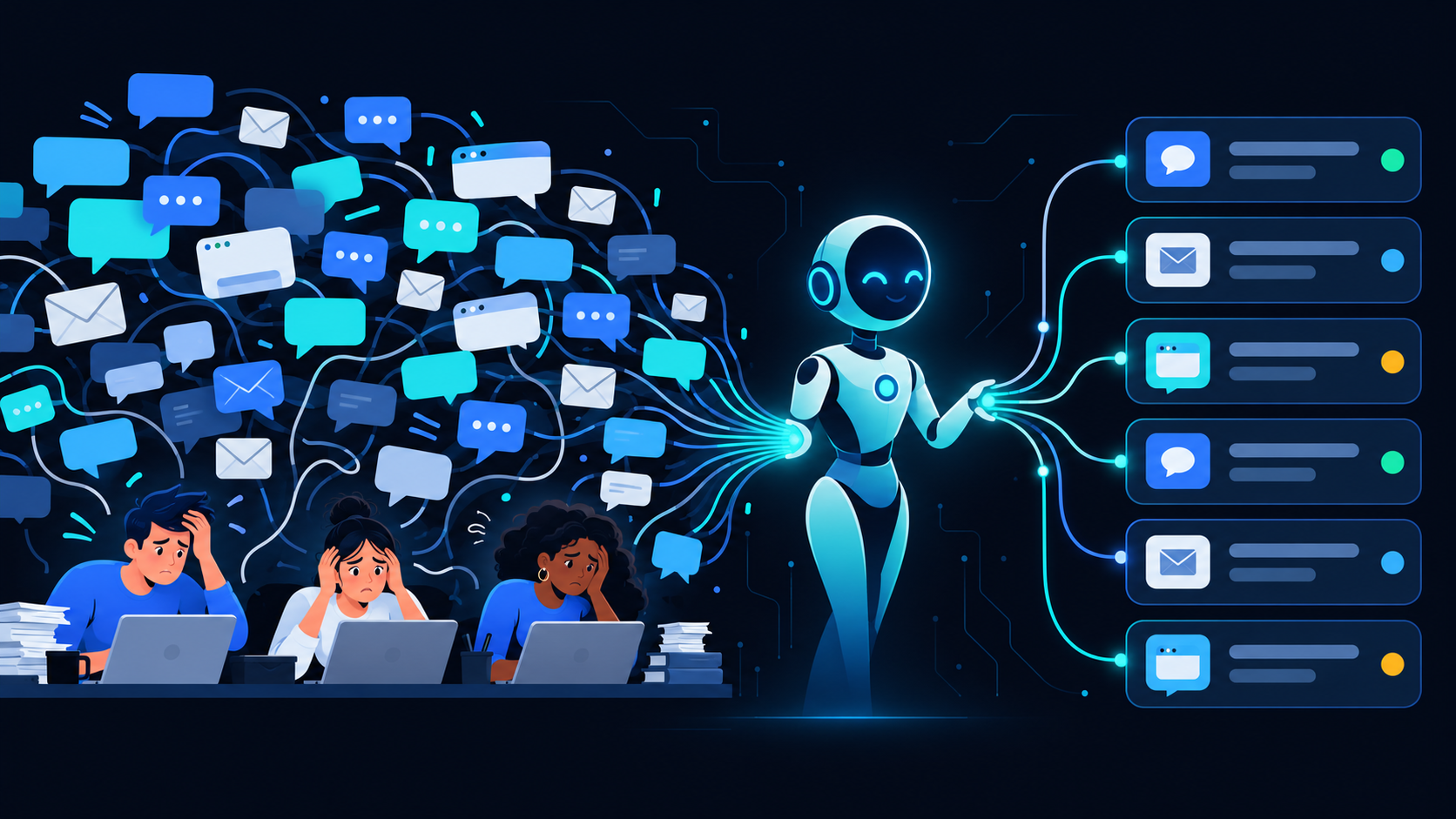
The E-Commerce Operations Problem
Small online retailers face a unique challenge: customer expectations are set by Amazon, but your budget is set by your revenue. The result?
- Support volume spikes during launches, holidays, and flash sales
- Returns processing eats 10-15 hours per week for a 10-person team
- Order status inquiries make up 40-60% of all support tickets
- Inventory questions (“Is this back in stock?”) come in 24/7
- Stop Losing Customers to Slow Support: How AI Handles 80% of Tickets for SMBs
You cannot hire your way out of this. A full-time support agent costs $36,000-$48,000/year, and they still cannot cover nights and weekends. Many SMBs are finding that deploying AI employees with a structured implementation plan is far more cost-effective than scaling headcount.
What AI Employees Actually Do for E-Commerce
An AI employee is not a chatbot. It is a trained digital worker that handles complete workflows. Here is a breakdown of what a digital employee can do compared to a human hire in e-commerce operations.
1. Customer Support Triage and Resolution
AI employees read incoming tickets, categorize them, and resolve the straightforward ones — order status, shipping questions, product availability, return eligibility checks. For complex issues, they draft a response and route to a human with full context.
Typical result: 50-70% of Tier 1 tickets resolved without human intervention.
2. Returns and Refunds Processing
The AI checks return eligibility against your policy, generates return labels, updates inventory, and processes refunds. It handles the entire workflow from “I want to return this” to “your refund has been issued.”
Typical result: Returns processing time drops from 24-48 hours to under 2 hours.
3. Order and Inventory Queries
Instead of your team manually checking Shopify or WooCommerce dashboards, the AI pulls real-time order status, tracking info, and inventory levels. Customers get instant answers, even at 2 AM.
Typical result: 80% of “where is my order” tickets handled instantly.
4. Vendor and Purchase Order Management
AI employees can draft purchase orders based on inventory thresholds, follow up with suppliers on delivery timelines, and flag discrepancies. This alone saves 5-8 hours per week for operations managers. For a deeper look at procurement automation, see our guide on why SMBs should automate procurement before adding headcount.
Real Numbers: AI Employee vs. Hiring
| Metric | Hire Support Agent | AI Employee (EchoAI) |
|---|---|---|
| Annual Cost | $36,000-$48,000 | $2,880-$5,760 |
| Coverage | 8 hrs/day | 24/7 |
| Onboarding Time | 2-4 weeks | 1-2 days |
| Ticket Capacity | 40-60/day | Unlimited |
| Consistency | Varies | 100% policy-compliant |
For a detailed cost comparison, check our analysis of AI employee costs vs. hiring for 50-person companies.
Getting Started: The 2-Week Pilot
Most e-commerce SMBs start with a focused pilot:
Week 1: Connect your support platform (Zendesk, Freshdesk, Gorgias, or email). The AI learns your policies, return rules, and product catalog.
Week 2: AI handles tickets with human oversight. You review, correct, and the AI improves. By end of week two, it is resolving 50%+ of tickets independently.
No multi-month implementation. No $50,000 consulting engagement. For a full step-by-step plan, follow our 30-day AI employee implementation guide for SMBs<\/a>. Just connect, train, and deploy.
Common Objections
“What if the AI gives wrong answers?”
Every AI response is policy-bound. It cannot make promises outside your rules. You set the boundaries; the AI operates within them. During the pilot, every response is reviewed before going live. For common pitfalls to avoid, see our guide on the most expensive AI automation mistakes SMBs make.
“My customers will hate talking to a bot.”
EchoAI does not sound like a bot. If you are curious about deploying AI customer service on messaging platforms, see our guide on setting up an AI customer service agent for WhatsApp in 7 days<\/a>. It writes like a helpful human — natural language, no scripted responses. Most customers cannot tell the difference, and they definitely prefer instant answers over 24-hour wait times.
“We already use [Zendesk/Freshdesk/Intercom].”
Great — EchoAI plugs into your existing tools. It does not replace your helpdesk; it powers it. Think of it as adding a tireless team member to your current setup.
What This Means for Your Bottom Line
A 10-person e-commerce team that deploys an AI employee typically sees:
- $30,000-$40,000/year saved on support labor
- 40-60% faster ticket resolution times
- 2-5 hours/day freed up for the founder/ops manager
- Higher CSAT scores (customers get faster responses)
- Stop Losing Customers to Slow Support: How AI Handles 80% of Tickets for SMBs
That is not a hypothetical. That is what happens when you stop paying humans to answer “where is my order?” for the 400th time.
Ready to See It in Action?
If you are running an e-commerce business with under 50 people and spending too much time on repetitive support tasks, it might be time to try an AI employee.
Related Reading
- Day in the Life: What It’s Like Working Alongside an AI Employee
- AI Employee vs. Hiring: What 50-Person Companies Actually Spend
- Stop Losing Customers to Slow Support: How AI Handles 80% of Tickets for SMBs
Book a free demo and we will show you exactly which workflows to automate first — based on your actual ticket volume and patterns.
Ready to take action?
Deploy a Digital Employee in 7 Days
See how EchoAI automates customer service and sales workflows — live demo, zero commitment.
Book a Free Demo →